

Why Position Sizing Cannot Rescue a Bad Stock Selection Process
Position sizing matters.

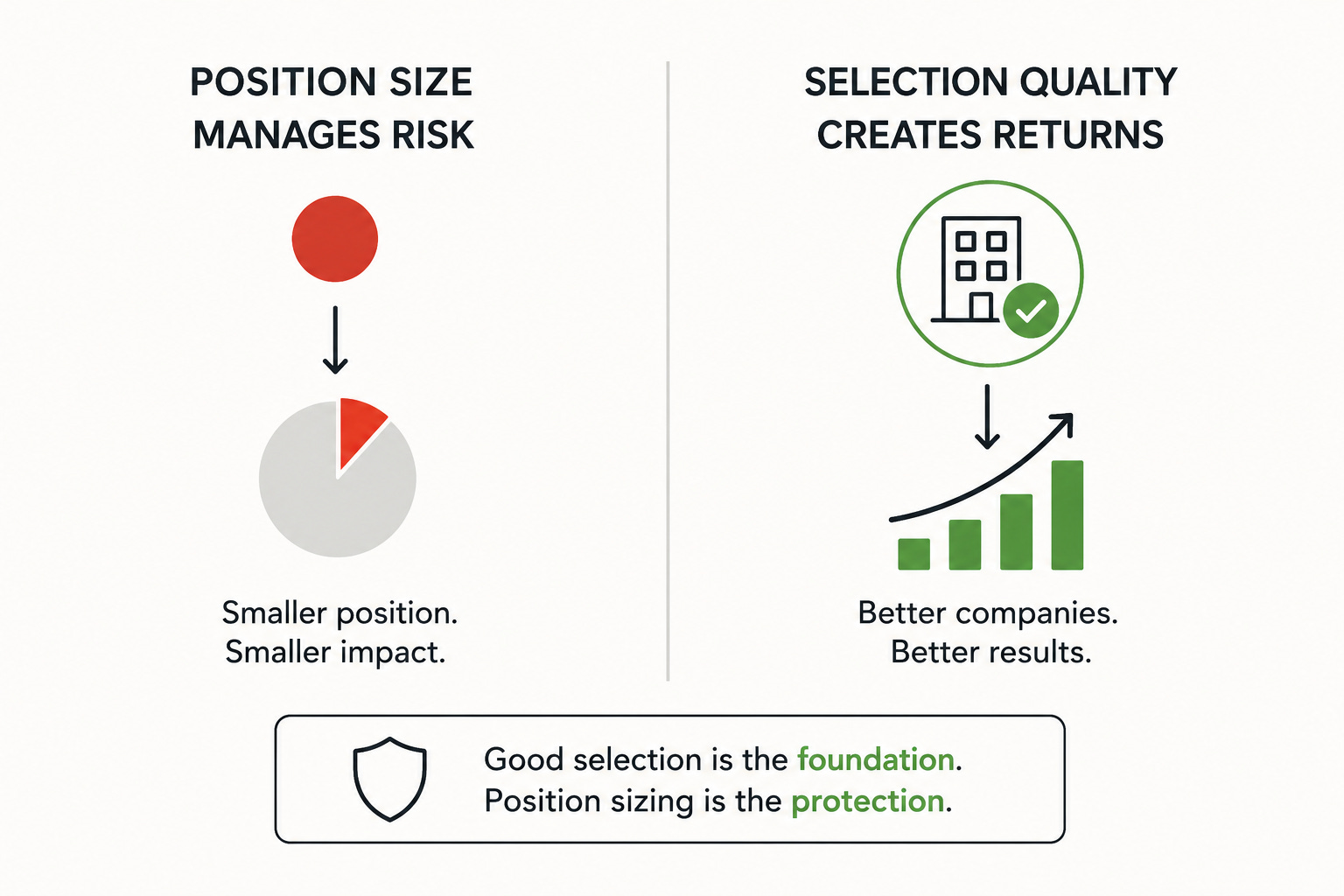
A smaller position limits damage. Equal weighting reduces overconfidence. Portfolio constraints stop one company from controlling everything.
But position sizing cannot transform a bad company into a good investment.
It can only control how much the mistake hurts.
A smaller bad investment is still bad
Suppose a company has:
Weak cash flow
Excessive debt
Persistent dilution
Deteriorating revenue
An unreasonable valuation
Giving it a 2% position instead of a 10% position reduces the potential loss.
It does not improve the business.
Risk management should protect a good selection process—not replace one.
This is why a stock screener should reject more than it selects.
Some weaknesses should prevent a company from entering the portfolio at all.
Diversification can hide weak standards
An investor may believe owning twenty risky companies is safer than owning one.
It probably is.
But spreading capital across many weak ideas can create a portfolio that is diversified only in name.
The companies may share:
Poor balance sheets
Speculative valuations
Weak profitability
Dependence on cheap financing
Unreliable financial data
The individual positions are small.
The portfolio-level exposure is still large.
Several stocks can remain one economic bet, which is the hidden danger discussed in The Hidden Risk of Owning Several Companies With the Same Economic Exposure.
Allocation begins after selection
Stock selection and portfolio allocation solve different problems.
Selection asks:
Does this company deserve consideration?
Allocation asks:
How much capital should it receive, and does it improve the portfolio?
The allocator should not be forced to repair companies that should never have passed the first test.
That is why I separate stock selection from portfolio allocation.
The sequence should be:
Classify the company correctly.
Reject unsuitable candidates.
Rank the survivors.
Combine them into a resilient portfolio.
Decide position sizes.
Reversing that order creates false safety.
Position sizing protects against uncertainty
Even a carefully selected company can fail.
The future remains uncertain.
A position limit protects against:
Unexpected competition
Fraud
Regulation
Management mistakes
Economic shocks
Errors in the investment thesis
That is the proper role of sizing.
It protects the portfolio from being confidently wrong about an otherwise reasonable idea.
It should not provide permission to buy something that already fails the strategy’s basic standards.
Equal weighting is not a substitute for quality
Equal weighting can be a strong starting rule.
It prevents one ranking difference from creating an enormous concentration.
But ten equally weighted weak companies remain a weak portfolio.
The system still needs to identify companies with acceptable:
Financial health
Cash generation
Valuation
Liquidity
Data quality
Business-model fit
Good allocation cannot manufacture good ingredients.
The final lesson
Position sizing controls consequences.
Stock selection controls what risks enter the portfolio in the first place.
Both matter, but they are not interchangeable.
A bad company with a small weight may cause less damage.
A portfolio full of small bad decisions can still fail.
The first line of defence is not deciding how little to own.
It is deciding what should not be owned at all.