

The Difference Between a Database and an Investment Strategy
A database can contain millions of financial records without knowing whether a single stock is worth buying.

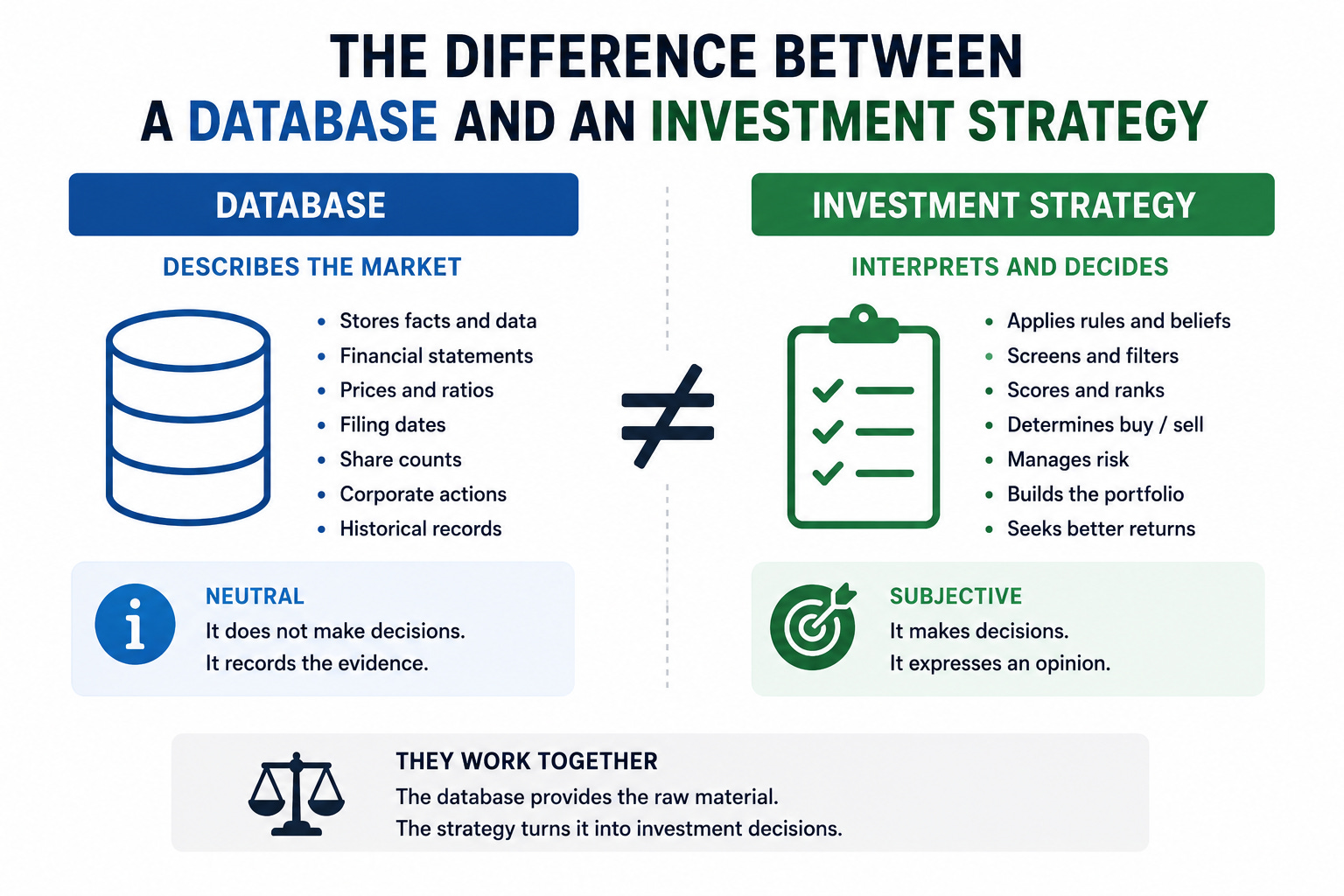
An investment strategy can produce a clear buy signal while depending on only a small part of that database.
These two systems work together.
They are not the same thing.
The database preserves evidence.
The strategy applies beliefs, rules, and objectives to that evidence.
Confusing those responsibilities can create a system that appears intelligent but is difficult to verify, modify, or trust.
That is why I treat my financial database and my investment strategy as separate parts of the project.
A database describes
A financial database attempts to describe the market.
It may contain:
Company identities
Financial statements
Filing dates
Reporting periods
Share prices
Trading currencies
Exchange rates
Share counts
Corporate actions
Industry classifications
Missing-data records
Provider metadata
None of these facts tells the investor what to do by itself.
A company reported $500 million in revenue.
Its share count increased by 4%.
Its debt declined.
Its stock traded at a particular price.
These are observations.
They become investment information only after a strategy places them into context.
A strategy decides
An investment strategy asks questions that the database cannot answer alone.
For example:
Is the company profitable enough?
Is its debt manageable?
Is the valuation attractive?
Is growth healthy?
Is dilution excessive?
Does it fit the portfolio?
Should it be rejected?
How much capital should it receive?
These questions depend on objectives.
A conservative value strategy and an aggressive growth strategy can examine the same company and reach opposite conclusions.
Neither conclusion is stored naturally inside the company’s financial statements.
The difference comes from the rules being applied.
Facts do not contain their own verdict
Suppose a company has debt-to-equity of 1.8.
Is that high?
The database cannot answer without additional context.
For a stable infrastructure business, the debt may be manageable.
For a fragile cyclical company, it may be dangerous.
For a bank, the ratio may not even be the correct way to think about financial structure.
The number is real.
The verdict depends on the business model and the investment strategy.
That is why facts and conclusions should remain distinguishable.
The same database can support opposing strategies
Imagine two investors studying the same market.
The first searches for high-quality companies with stable cash flow and moderate valuations.
The second searches for distressed companies with a chance of recovery.
The quality investor may reject a business because:
Earnings are negative
Debt is rising
Revenue is falling
Cash flow is unstable
The distressed investor may examine that exact company because those weaknesses caused the price to collapse.
Both strategies can use the same database.
They simply interpret the evidence differently.
A database should not quietly delete the company because one strategy does not want it.
The evidence may still matter to another strategy—or to evaluating whether the first strategy’s rejection rule was useful.
A screener belongs to the strategy layer
A stock screener often looks like a database tool because it searches financial fields.
But a screener is already expressing an investment opinion.
The moment it says:
Market capitalization must exceed $300 million
Free cash flow must be positive
Debt-to-equity must remain below 2.5
Price-to-free-cash-flow must remain below 25
it has moved beyond recording facts.
It is applying a strategy.
The company does not become objectively unsuitable because it failed those rules.
It becomes unsuitable for that particular investment process.
This is why a screener’s role should be understood clearly:
A Stock Screener Should Reject More Than It Selects

Enter a few financial conditions, press a button, and receive a list of investment ideas.
The database stores the company.
The screener decides whether the company may proceed.
The database should not care which strategy wins
A reliable database should remain neutral between competing ideas.
Suppose Strategy A performs better when it emphasizes valuation.
Strategy B performs better when it emphasizes quality.
Strategy C performs better when it combines both.
The underlying historical evidence should remain unchanged across all three tests.
If each strategy uses a differently cleaned or differently filtered version of history, the comparison becomes unfair.
The database should create a common world.
The strategies should compete inside that world.
Strategy rules should remain replaceable
Investment theories change.
A ratio that appears powerful in one test may fail in another.
A threshold may turn out to be too strict.
A company classification may need improvement.
The portfolio may require stronger country limits.
These are normal research developments.
If the rules are embedded directly into the data, changing the strategy may require rewriting the database.
That risks changing the historical world whenever the investment theory changes.
A better design keeps the evidence stable and makes the strategy replaceable.
This is the broader architecture behind:

The database should outlive individual strategies.
A database is broader than a strategy
A strategy uses only the fields needed for its current decisions.
The database should usually preserve more.
A general operating strategy may currently care about:
Revenue
Net income
Free cash flow
Debt
Book value
Share count
Valuation
But future research may need:
Inventory
Receivables
Lease obligations
Interest expense
Research spending
Segment results
Acquisition history
Customer concentration
If the system stores only what one strategy currently requires, future questions become impossible to test.
The database should preserve possibilities.
The strategy should narrow them into decisions.
A strategy is more than a formula
It is easy to imagine an investment strategy as a scoring equation.
Perhaps value receives 25%, quality receives 25%, growth receives 20%, and safety receives 30%.
But a complete strategy contains much more.
It includes:
Which companies are eligible
Which business models are excluded
Which data is required
Which values trigger rejection
How companies are ranked
How many positions are held
How often the portfolio rebalances
How positions are sized
When a stock is sold
How trading costs are handled
What happens when no candidate qualifies
The database cannot make these choices automatically.
They reflect the investor’s goals and tolerance for uncertainty.
The database can be correct while the strategy is wrong
Suppose the financial data is accurate.
Prices, currencies, filing dates, and share counts have all been handled correctly.
The strategy still performs poorly.
Perhaps it:
Overvalues growth
Ignores deterioration
Uses weak valuation measures
Concentrates in one industry
Trades too frequently
Overfits historical relationships
This is a strategy failure, not a database failure.
The distinction matters because the repair is different.
The data does not need to be recollected.
The investment rules need to be reconsidered.
The strategy can be reasonable while the data is wrong
The opposite can also occur.
The strategy may have sensible rules, but it receives:
A stale stock price
The wrong company’s financial statement
An outdated share count
A currency mismatch
A duplicated filing
A future filing inside a historical test
The strategy produces a bad decision because the evidence was corrupted.
Changing the investment rules will not repair the problem.
The pipeline must be fixed.
This is how poor inputs can manufacture attractive-looking stocks:
How Bad Financial Data Creates Fake Investment Opportunities

Its earnings may be attached to the wrong share price.
A system must know whether it misunderstood reality or received the wrong reality.
The distinction makes failures useful
When an investment system fails, I want to know where it failed.
Was the problem:
Source data?
The provider returned an incorrect or incomplete record.Transformation?
Currency, units, dates, or corporate actions were handled incorrectly.Classification?
The company was judged using the wrong business model.Screening?
The mouth admitted a company that should have been rejected.Scoring?
The strategy emphasized the wrong financial characteristics.Allocation?
Reasonable companies were combined into a fragile portfolio.Uncertainty?
The process was defensible, but the future still went badly.
Each failure teaches a different lesson.
Mixing the database and strategy together makes these lessons harder to recover.
A database should preserve rejected companies
When a strategy rejects a company, the company should remain in the database.
Otherwise, the research history becomes biased toward the strategy’s preferences.
Rejected companies are valuable because they allow the system to measure:
How many later recovered
How many failed
Whether thresholds were too strict
Whether missing data caused excessive rejection
Whether the strategy avoided major losses
Whether certain business types were treated unfairly
A database should preserve the full population.
The strategy creates a temporary eligible population from it.
The database should also preserve the strategy’s decisions
Keeping the layers separate does not mean investment decisions should disappear.
The system should record:
Which strategy version ran
Which companies were eligible
Which companies were rejected
Why each rejection occurred
Which scores were produced
Which portfolio was constructed
Which data snapshot supported the decision
This creates an audit trail.
The decision belongs to the strategy layer, but it should be permanently associated with the evidence that produced it.
Raw evidence allows the strategy to be rebuilt
Suppose I later discover that my definition of free cash flow was too simplistic.
If raw cash-flow records remain available, I can create a better definition and rerun the strategy.
Suppose a country requires a different filing-availability policy.
The historical snapshots can be rebuilt.
Suppose an entire business category needs specialized metrics.
The companies can be reclassified and reprocessed.
This is possible because the evidence was preserved before the strategy compressed it into scores.
That is why raw history should survive every current model:
Why I Keep Raw Financial Data Forever

It has consistent names, standardized currencies, resolved duplicates, aligned periods, and calculated investment metrics.
Strategies are experiments.
The raw warehouse is the laboratory record.
A database does not create an edge by itself
A large financial database may be valuable infrastructure.
But possessing more data does not automatically produce better investment decisions.
The investor still needs to decide:
Which information matters
Which relationships are durable
Which companies are comparable
Which risks deserve rejection
Which valuations provide enough margin of safety
A database can make research possible.
It cannot guarantee that the research question is intelligent.
More information can produce more sophisticated mistakes when the strategy lacks discipline.
A strategy does not create truth
A strategy can express a strong opinion.
It can rank every company from best to worst.
That confidence does not make the conclusion true.
A precise score may rest on:
Uncertain estimates
Arbitrary weights
Weak historical relationships
Incomplete data
An overfit backtest
The strategy should therefore remain accountable to the evidence.
It should be possible to trace every conclusion backward.
The more decisive the output, the more important that chain becomes.
Machine learning still belongs to the strategy layer
A future machine-learning model may identify relationships too complicated for fixed rules.
It might estimate future returns, risk, or the probability of deterioration.
But the model is still an interpretation system.
It learns from selected features and selected outcomes.
Its predictions depend on choices involving:
Training periods
Feature definitions
Labels
Missing-data handling
Model architecture
Validation rules
The model does not replace the database.
It depends on it.
Powerful models increase the need for reliable, traceable evidence because mistakes become harder to see inside complex predictions.
The portfolio is not stored in the company data
A company can look attractive individually and still be a poor portfolio addition.
The database may show that several oil producers are financially strong and inexpensive.
The selection strategy may rank all of them highly.
The portfolio layer must recognize that owning several of them creates one large commodity exposure.
This is another example of a decision that exists outside the raw company facts.
The database describes each tree.
The portfolio strategy decides how the forest should be assembled.
Strategy performance should not rewrite the data
Suppose a strategy performs badly during a certain period.
There may be a temptation to:
Remove unusual companies
Replace inconvenient missing values
Adjust classifications
Change the historical universe
Prefer a different provider because it produces better results
Some corrections may be legitimate.
But data changes should be made because they improve accuracy, not because they improve strategy performance.
The database should not be optimized to make the strategy look intelligent.
The strategy should be tested against the most honest database available.
One supports many; the other chooses one path
The database should be capable of supporting many strategies.
A value strategy may use it one way.
A quality strategy may use it another.
A bank-specific model may select different nutrients from a miner-specific model.
The strategy chooses one path through the evidence.
That path may succeed or fail.
The database remains available for the next question.
A useful architectural sequence
The project can be understood as a series of distinct layers:
Raw warehouse
Preserve filings, provider responses, prices, currencies, identities, and metadata.Cleaning and normalization
Resolve units, dates, corporate actions, mappings, and obvious contradictions.Point-in-time snapshots
Reconstruct what information was available on each historical decision date.Business classification
Determine which financial rules belong to each company.Screening
Reject candidates that fail non-negotiable requirements.Feature compilation and scoring
Calculate relevant nutrients and rank the survivors.Portfolio allocation
Combine companies while controlling position size and shared risk.Outcome tracking
Record what happened after the decision.Validation
Test whether the strategy survives unseen conditions.
The first three layers primarily construct the historical world.
The later layers decide how to act inside it.
The distinction creates trust
When data and strategy are separated, the system can answer two different questions.
What did the system know?
This can be traced through:
Source records
Filing dates
Prices
Currencies
Missing values
Transformations
Why did the system act?
This can be traced through:
Strategy version
Screening rules
Scores
Thresholds
Portfolio constraints
Position sizes
Trust requires both answers.
A decision without evidence is unsupported.
Evidence without a decision process cannot explain the portfolio.
The database is memory; the strategy is policy
A useful way to understand the distinction is:
The database is memory.
It preserves what entered the system.
The strategy is policy.
It determines how the system responds.
Memory should be broad, durable, and honest.
Policy should be explicit, testable, and replaceable.
A system with policy but no reliable memory repeats mistakes.
A system with memory but no policy collects information without acting.
Both are necessary.
Neither should impersonate the other.
The final difference
A database asks:
What happened, when did it happen, and what evidence do we have?
An investment strategy asks:
Given that evidence, what should we reject, select, own, and risk?
The database attempts to reconstruct reality.
The strategy expresses a disciplined opinion about that reality.
The database can be accurate while the strategy fails.
The strategy can be sensible while the data pipeline fails.
Keeping them separate allows the project to discover which one needs repair.
The database remembers every company, including the failures and rejected candidates.
The strategy chooses which companies matter for one particular objective.
The database should survive changes in investment theory.
The strategy should earn trust through testing.
One preserves the world.
The other decides how to move through it.
That is the difference between a database and an investment strategy.
The separation between data and strategy is especially important because precision can create false confidence. A database can tell you exactly what happened, while the investment process still makes a poor decision by weighting the wrong factors, ignoring differences between business models or market environments, or sizing the position badly. Being able to distinguish a data failure from a thesis, portfolio-construction, or ordinary uncertainty failure is what makes the process genuinely improvable.